aside from the heavily anthologized "we real cool" i hadn't read a line of gwendolyn brooks until the other day. the selected poems that's in print first appeared all the way back in 1963, adding only a few "new" poems after the bean eaters (1960), thus missing out on the entire impact of the black nationalist movement on her poetry. this too marks, as i understand it, her move away from mainstream publishing houses (harper & row) and her earlier formalist and more visibly and earnestly "modernist" style into free verse and a more direct kind of language and portraiture (fully realized in 1968's in the mecca).
curiously, and while i have not seen much of the former, it's the latter i'm more immediately drawn to, like the poems from annie allen (1949). stanzas like the following from her mock/mini-epic "the anniad":
Yet there was a drama, drought
Scarleted about the brim
Not with blood alone for him,
Flood, with blossom in between
Retch and wheeling and cold shout,
Suffocation, with a green
Moist sweet breath for mezzanine
* * *
Tests forbidden taffeta.
Meteors encircle her.
Little lady lost her twill,
Little lady who lost her fur
Shivers in her thin hurrah,
Pirouettes to pleasant shrill
Appoggiatura with a skill.
 this is supertight formalism: seven-syllable lines, three trochees with an extra strong beat at the end, and seven-line stanzas with three endrhymes (two in pairs and one in threes in no set pattern). the soundplay is rich, the diction alternating between plain and stylized, the syntax compressed, the imagery striking... all packs quite a punch.
here's an entire poem from the section of annie allen called "the womanhood," one that starts off in a seemingly uninteresting "observations about life" mode but quickly turns into a stunning array of sensible and sonic ingenuity, culminating in the phrase that serves as the subject line of this email.
the metaphor "mail of ice" tells me straightaway i'm in for something interesting. lines 5 and 6 have some great alliteration, and the movement line 8 from the infinitives to the extended modifiers is great. the third "quatrain" continues the rich play of sound and striking images "throttling dar," "whimper-whine," all of which set up the repetitions of the verb "to make" in the closing couplet and that stunning metaphor, "a sugar of the malocclusions."People who have no children can be hard:
Attain a mail of ice and insolence:
Need not pause in the fire, and in no sense
Hesitate in the hurricane to guard.
And when wide world is bitten and bewarred
They perish purely, waving their spirits hence
Without a trace of grace or of offense
To laugh or fail, diffident, wonder-starred.
While through a throttling dark we others hear
The little lifting helplessness, the queer
Whimper-whine; whose unridiculous
Lost softness softly makes a trap for us.
And makes a curse. And makes a sugar of
The malocclusions, the inconditions of love.
it's really no curiosity why these lines appeal to me, but i can't help feeling like they're caught in an uneasy dynamic. i think of melvin tolson, a clear master of modern style, admired by allen tate but then dismissed by a younger generation of black poets for his embrace of white/european forms. it's a tension all over the early baraka, and you can see it in harryette mullen as well (in tall tree woman vs trimmings). with brooks it's clearly not a simple choice between anglo-modernism or afro-realism, since traces of both run throughout the 1963 selected poems. i'll have to check out her post-1968 work.
clearly this is also a major body of work whose time is right for for a collected edition of some kind or other.
 pretty pleased with this purchase, a bargain-priced 4CD set that i picked up for half-price over the weekend. i've been wanting a good set of schumann for a while, and this set takes me back to the days when i was borrowing classical LPs from the georgetown branch of the dc public library and recording them onto cassette, this musta been some 15 years ago. claudio arrau's
  kempff does a mean final schubert sonata and also pretty nice readings of the late beethovens (tho not as great as gilels) so i assumed he'd do a more than competant schumann and so far i've not been disappointed. these are old recordings -- mostly early-to-mid 1970s but some as far back as 1967 -- so they don't always have super crisp modern production values but often have a nice warmth, like with the lovely chopinesque opening of the papillons op.2. the "preamble" of the
  schumann is such a great melodist and like his student brahms he could concentrate so much into a turn of phrase, but he's also a miniaturist like chopin. this has me thinking now about distinctions between practitioners of the short form in romantic piano. surely as goethe was so dominant a figure in german poetry that he drove many subsequent would-be-poets into philosophy, beethoven's sonatas drove composers into shorter forms for piano. the collections of short pieces by chopin and schuman dwarf anything they accomplished in the sonata. (even schumann's great long piece for piano is the fantasy rather than any sonatas i think).
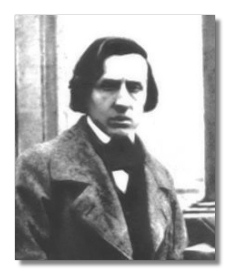 and yet chopin's mazurkas, for example, feel like complete whole while his 24 preludes are these flashes of brilliance that could each be fleshed out into its own full-length sonata i feel. so i guess the question i'm posing is the relation between thematic material and the feel for the whole, that is whether the short piece feels like a fragment or whole unto itself. brahms of couse got his piano sonata out of the way early and ended up with those collections of shorts late in his career (which i also have kempff doing but have never gotten into much). maybe i'll be listening for this stuff in the days to come.
 is there a specific moment in the track? cuz i've got it going here now and can't hear no mingus, but you know the mingus better than me. what i do hear in simmons' initial statements over the ensemble (0:37-0:38) is a two-note descending figure at an interval of (i think) a fifth that's very very close to the opening of coltrane's "father son and holy ghost" (from MEDITATIONS), occurring six times from 0:37 to 1:04. plus simmons' embellishments of that motif (0:47-0:49, 0:59-1:04) strike me as being very coltranesque figures. then the very first statement in his solo proper (1:25-1:25), which is also the song's opening theme, sounds like a little nod at "a love supreme" or perhaps even "sun ship." it makes sense too that since simmons is, i believe, playing tenor on this track, he would make some coltrane references.
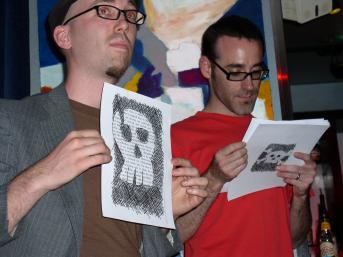 jamie's set offered a variety of work, some individual poems including a kind of twisted valentine for tracey, along with excerpts from two larger projects. one was something he called tender buttons skulls i think (depicted left), in which texts was accompanied by b&w images of skulls. not sure what the relationship was between the two but my impression was of a tribute/ratcheting-up of stein: indeed one of the poems was a delicious heap of shredded verbiage. the other project involves dialogues for different kinds of robots. i've heard jamie read these before and they are very hilarious, playing with ideas of cyberlove and safe versus dangerous internet behavior for children. the dialogues are full of all kinds of inappropriate Qs and As, and jamie's friend john served his interlocutorial duties well.
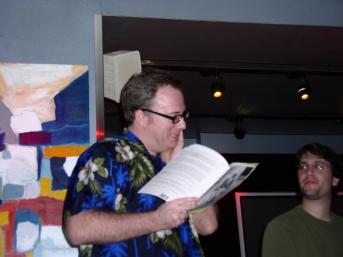 dan read the "bohemian rhapsody" poem from his tribute book to the rock band queen (even tho he offered to take requests and a number of us shouted "killer queen"). i'm less a fan of the schtick than dan is developing, which seems to take masturbation as one focal point (nothing wrong with that per se of course, his efforts to be frank and open about it are not entirely convincing to me) than of his autobiographical mode in which his love of music of all kinds, his aspirations, fears and uncertainties shine forth with a straight-up honesty that's very refreshing. was good to chat with him too and find out that he's happy in albany with a good job and a good poetry crew in the neighborhood.
 The officials said Cheney's legal adviser and chief of staff, David Addington, is the Bush administration's leading architect of the "signing statements" the president has appended to more than 750 laws. The statements assert the president's right to ignore the laws because they conflict with his interpretation of the Constitution.
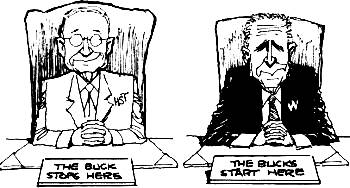 yesterday at a commencement speech at west point, bush
  discovery of the week: you're in the second story books warehouse in rockville, 50% off everything in the store, trolling through the poetry section and there's this weird, thin green-and-beige spined book with the words "edinburgh bilingual library" and "selected poems" by someone you've never heard of printed on it, so of course you pick it up and read.
 it's kenneth rexroth, from

 which in some settings is exactly what you want, but like anything this kind of rigorous purity can be self-defeating. i have a CIMP recording of a marc edwards trio with drew's friend sabir mateen on reeds and hilliard greene on bass -- it might as well be a reeds/drums duo recording for all intents and purposes as hill is virtually inaudible for most of the disc.


 preconceptions, generalizations and stereotypes often lead you astray. i've always had this notion of what "the ECM sound" is all about -- clarity in sound production values, austerity in performance values -- but these characterizations, however accurate, do not automatically yield kenny g no matter how much one might be inclined to think they do. after all, ECM is the label that mainstreamed the art ensemble of chicago; after seeing the AEC for the first time at the cleveland art museum during black history month in 1989 and having my little 21-year-old mind blown away, it was their albums on ECM that i found at the local public library.

 still, and especially in recent years, it's the cooler, calmer avant-garde jazz that ECM features rather than the scorched earth avant-garde. nothing ever was, anyway, the marilyn crispell trio double CD tribute to annette peacock, is some of crispell's most lyrical playing i've heard, a far cry from her earlier cecil tayloresque dates for leo records. the bley-peacock-motian trio not two, not one is also a stunner, as stark as the light and shade in its black and white cover. the series of evan parker electro-acoustic ensemble discs, now numbering four, are wonderful logical progressions not of parker's high-energy trio work (with guy & lytton or schlippenbach & lovens) but the sustained interwoven textures of the music improvisation company recordings of the late 1960s and early 1970s.
 but is it possible for ECM stuff to ever really get out out out, or just plain rock? the answer is yes. i should've taken my clue from a john abercrombie LP i picked up a while back, gateway (1975). i know, an ECM guitarist? what could be closer to windham hill new age pap? think again. with a rhythm section of holland and dejohnette, this trio knows how to rock and abercrombie can make a stab at hendrix and pull it off better than most.
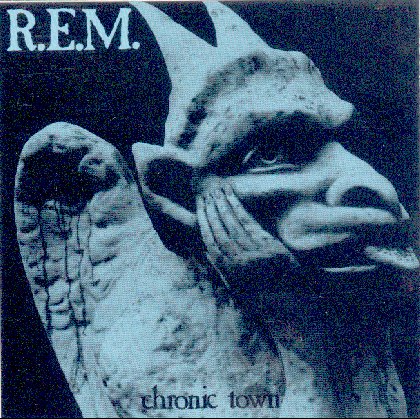
 so recently i'm looking into jan garbarek. cold, austere, nordic, i know. so they say. and i'll be damned if the cover of his first ECM recording, afric pepperbird doesn't look about as cold, gray and nordic and far removed from anything afric as you could imagine. well look for this one if you can find it cuz if a live show i've been listening to by the same band (Jan Garbarek tenor and bass saxophones, clarinet, flutes, percussion; Terje Rypdal guitar, bugle; Arild Andersen bass, african thumb piano, xylophone; Jon Christensen percussion) from the same time period (1971) is any indication it rocks. hard. frankly it sounds like bitches brew on jaegermeister and bad LSD. how could a band with a guitarist named terje pull this off? well he does it -- and not so much by going for hendrix like abercrombie but, i dunno, krautrock guitarist michael karoli of can. seriously, rypdal at this time period gets some of the most interesting wall-of-electronoise guitar sounds i've heard from anyone, in any context.
 and what about garbarek? well personally i'll pass on that best officium recording with the hilliard ensemble (the penguin guide calls it an exercise in "faith minimalism," which is i guess why ECM records recent arvo part too -- tho don't be fooled, part's early stuff is very solid post-serialist composed music) because on afric pepperbird he's pretty out there, reminding me a bit actually of early gato barbieri tho with less ayler/sanders and more coltrane. the other one of his to keep an eye out for is witchi-tai-to (1973), which is actually attributed to the jan garbarek-bobo stenson quartet. again based on a live recording i have from the same band same period, here the coltrane comparison is even more appropriate because of the lineup and garbarek's sound (which has, by this time and like barbieri's, lost any aylerisms it might have had). stenson is an interesting, folksy lyrical pianist, and the rhythm section (Palle Danielsson, bass; Jon Christensen, drums) is incredibly fluid and powerful.