Showing posts with label art. Show all posts

Thursday, November 22, 2007

transforming structures of the world proposed

Work by Matthew Kolodziej and Hildur Ásgeirsdóttir Jónsson currently on display at William Busta Gallery in Cleveland propose to this viewer ways of rethinking and renewing the legacy of Abstract Expressionism. It's as if, paraphrasing what Busta said in agreement with me when I visited yesterday afternoon, we have enough distance now from Pollack that an "all-over" approach to the application of paint to canvas is possible again. Where Kolodziej and Jonsson depart from their forebears, however – and it is a significant but of course arguable departure – is how, eschewing formalism for its own sake, they subtly reinscribe the social and material world into their paintings.

Kolodziej's EnhanceDan Tranberg's write-up in this Sunday's Plain Dealer and the reproduction of a Kolodziej painting it contained are what caught my attention (see, for example, Enhance [2007]). The interplay of line and color seemed to arise from spontaneity into abstraction while somehow retaining vestiges of order; the PD's caption, "the artist begins his process with photographs of buildings, which he projects and traces onto his large canvases," was enough to make me stop reading, put down the paper and plan to head down to the gallery (located in near midtown, not that far from where those classic Pere Ubu albums were recorded).

Buildings, constructions, sites, non-sites, exist and are inhabited in both space and time. So also, Freud mused in The Interpretation of Dreams, "that Rome is not a human habitation but a psychical entity with a similarly long and copious past – an entity, that is to say, in which nothing that has once come into existence will have passed away and all the earlier phases of development continue to exist alongside the latest one." Architectural time passes much slower than clock time (but not as slow as geological time). A building can survive for centuries and yet be collapsed in a matter of minutes or seconds, the event of evacuated space leaving a traumatic scar that can reverberate at length.

Kolodziej's paintings capture and convey those spatial and temporal transitions, objects and moments of human construction and destruction that are transformed. But into what? Hard to say. The vestiges of structures remain, giving the paintings their formal necessity; nowhere however (save perhaps in the painter's studio or personal effects) are these structures identified with their material specificity. Kolodziej does not name names of buildings or sites: instead, these (non)sites are frequently transformed into abstractions, with titles like Pretense, Restoration, etc. Additionally, with (in Tranberg's words) "Kolodziej's color palette, which ranges from chocolate and carmel to raspberry and lemon, makes it difficult to see these scenes as true tragedies. [...] it's difficult not to read these paintings as representations of an absurdist, candy-coated culture of destruction."

An intriguing reading, but I don't quite agree. Kolodziej does not strike me as the cool ironist or cutting satirist. At least not entirely. These works won't be reduced to brute materialism or pure aestheticism; they capture and transform transitional, multiple states of matter and energy. From the artist's statement: "These improbable structures fluctuate between forming and deteriorating synapses." Indeed as Freud already suggested, this language of neuroplasticity is no mere metaphor when applied to physical structures.

Jonsson's Sandstorm"During the past 12 years, Hildur Ásgeirsdóttir Jónsson has created series of works based upon images of brains scans, celestial objects, and most frequently, the landscape of Iceland" (WBG exhibition brochure). These might be seen serving an analagous role to Kolodziej's (de)construction (non)sites, namely as the formal necessity for the painting. Jonsson's processes and results, at the very least, are quite different. Her paintings are equally textiles, as she weaves together singly-dyed strands of silk fiber. Her Sandstorm, depicted here, is the only image i could embed here and does not immediately resemble (and may have been achieved with a different process) her latest series, The Vatnajökull Paintings, named after the Icelandic glacier that is Europe's biggest. (Some of these are on display at WBG; you can view them at her website.) The exact nature of weaving process and the extent to which the paintings reference the glacier itself is not entirely clear to me; regardless, the effect is quite stunning. I was reminded of Gerhard Richter's squeegee-smeared surfaces, but Jonsson's woven silks have a depth that evokes overprinting, while the dying and staining evokes Helen Frankenthaler (who stained raw unprimed canvas but never single threads).

Like Kolodziej, the real word is serving as Jonsson's template here, and an order derived from the tangible world. These are no unfettered expressions of the genius ego. Instead, rigorous application of method in both cases works a transformation upon structures of the world proposed.

Monday, April 09, 2007

sol lewitt (1928-2007)


49 Three-Part Variations on Three Different Kinds of Cubes, 1967-71 (oberlin college)


Serial Project #1 ABCD 6, 1968 (thecityreview.com)


Cube Structures Basedon Five Models, 1971-74 (Crown Point Press, San Francisco)


1 2 3, 1978 (artcritical.com)


Wall Drawing No. 681 C, 1993 (National Gallery of Art, Washington)


2-3-1-1, 1994 (university of iowa)


Loops and Curves No 4, 1999 (Barbara Krakow Gallery, Boston)


Wall Drawing #1113 On a wall, a triangle within a rectangle, each with broken bands of color, 2003 (hirshhorn, washington)

Thursday, February 01, 2007

jasper johns at the NGA

Jasper Johns, Target With Four Faces (1955)the jasper johns show that went up on sunday at the national gallery offers a lot of food for thought about the nature of art, objects and representation. not a retrospective, this is a focused, formalist look at four specific motifs johns worked through over just the first ten years of his career: the target, the mechanical device used in his painting process, stenciled color names, and the body. the subtitle of the show, "an allegory of painting," suggests, if we are to take it literally, that each of these motifs enables johns to essentially tell a story about painting.

i'll have to give this some more thought, which i'm doing along with a reading of his interviews and sketchbook notes published in conjunction with the 1996 johns retrospective at the MOMA. but i'm not sure that each of these motifs offers an equally compelling "allegory of painting." clearly the targets and the stenciled color names are fascinating to the degree that they are (and are not) what they depict. johns is playing "signification games" that owe a lot to wittgenstein (whom as it turns out he was reading at the time); these devices seem to me like tools that johns uses to explore certain ideas and issues and then, like wittgenstein's ladder, disposes of when they are no longer of use i.e. have helped him reach a place that he needed to get to. blake gopnik literally gushes about johns in this sunday's washington post arts section, something he is rarely given to do in my infrequent readings of him. (i found it a pleasant coincidence his assertion of johns' "pictorial intellegence" relative to my recent listenings for "poetic intelligence.") i'm not sure, for example, how much johns really adds to, rather than simply reiterates (perhaps in a new context), the essential moves of duchamp. gopnik ultimately wants to make johns a comic genius along the lines of buster keaton; certainly this element is there, but it doesn't strike me as being of the essence. just in the targets alone, that body of work, i find a serial insistence that is methodically working through some serious issues. if it was just "giddy inventiveness" that compelled you to run versions of the same "joke" over and over, the work to me would get tired pretty quickly.

note: this show close at the end of april 2007 and goes from there to the kunstmuseum basel. (susana!) also, what look to be some interesting concerts and film screenings in conjunction with this show. performances of what appear to be violin sonatas by elliott carter and roger sessions (feb 18); piano music cage, feldman, ives and nancarrow (february 25); and ensemble music by cage (march 4). films related to johns and his milieu -- cunningham, cage, rauschenberg, brakhage, leslie (march 10) -- and documentaries on cage and carter (march 24).

Friday, January 05, 2007

barcelona and modernity

a quick look at the cleveland plain dealer's friday magazine reminded me of the exhibit at the cleveland museum of art, "barcelona & modernity: picasso, gaudi, miro, dali," which closes this weekend.

the CMA is in the midst of a massive, massive renovation and expansion. so much so that their entire permanent collection is closed, and either touring or in storage. the original building (1916) is getting a facelift and a complete internal overhaul while a new building or two (not sure exactly) are going up, that will dramatically enhance the amount of exhibition space. (in the past they museum was never able to show more than 4,000 of the 40,000 pieces in its collection). all should be completed by 2011.

"barcelona & modernity" was a very thorough look at both one city's contribution to modernism and modernism as filtered through the unique culture of one locale, roughly from the 1890s through the 1930s. hardly limited to painting (tho that's where most of my viewing attentions were directed), the exhibit included sculpture, graphic and commercial design, architecture, furniture and the decorative arts. much of the material was on loan from the many museums of barcelona itself, so this was indeed the next best thing to being there.

observations:

Mujer de noche, en Paris, H.Anglada-Camarasai love seeing and learning about work by (to me anyway) lesser-known contemporaries and near contemporaries of the great masters like picasso (b. 1881) and seeing how they fit into the overall aesthetic of the period. even picasso's early work fits for me into the broader backdrop of late 19th-century (and as i understand it largely french), pre-impressionist realism, the dark tableaus of manet and degas. (i think of their absinthe drinkers for example.) Mujer de noche (above, left) is by hermen anglada-camarasa (b. 1872), who was already established on the barcelona scene when a young picasso arrived there. he shared an interest in toulouse-lautrec with picasso, which the latter's end of the act shows (can't find a reproduction of this but imagine a gaudy-colored line of chorus girls).

pidelaserra, Muntanyes des del Montsenyhere's another case, the seuratian pointilism of marià pidelaserra (b. 1877), muntanyes des del montseny (right, courtesy of the museu nacional d'art de catalunya). other of picasso's contemporaries and immediate precursors included ramon casas (b. 1866) and santiago rusiñol (b. 1861), some of whose works in the show also displayed that dark, manet/degas realism/naturalism. all were part of the group centered around the cafe els quatre gats, where picasso had his first solo exhibition in february 1900. els quatre gats also generated an eponymous periodical, publishing 15 issues february-may 1899; the pages of these and other publications of the time, like l'avenc and joventut, were shared by picasso's contemporaries.

joaquim mir, The Rock in the Pondhere was another stunning piece, on loan from the MNAC, the rock in the pond by joaquim mir (b. 1873). in reality it looks much less crisp and focused than in person (unless it's my own failing vision that's responsible). the illusion of a reflective surface, the marvelous shades of blue as contrasted with and blended into the light and dark surfaces, the rock that could be a partially submerged skull or head (with the near flesh tones) -- without being given the title in advance it's a perfectly wonderful piece of fluid, organic abstraction much in line with that of his subsequent surrealist countrymen, miro and dali.

here's another great study in comparison between the young picasso and his french realist masters, one moulin de la galette each by renoir (above) and picasso (below).

picasso's less interested in the play of light and shadow, tho certainly contrasts light and dark. again tho, the darkness pervades.

picasso, la viehere of course is a classic early picasso, la vie. amazing about this piece is its persistant resistance to interpretation -- what is the relationship within and between the four sets of human figures? much ink spilled on the answers i'm sure, none definitive. scholars have even x-rayed the piece to find out what was going on in the original drafts, to see if any light can be shed. not much.

i love too how the hispanic cultures were often a decade or two ahead of the curve in terms of naming modernisme and the various other ismes. anglo-modernism was a good twenty to thirty years behind. but a new isme for me was noucentisme (literally newcenturyism), which was apparently a kind of nationalist, neoclassical rejection of modernisme's foreign influences and emotional excesses.

picasso's 1906 paintings while in gósol, a town right on a peninsula in pyrenes coast -- very reddish earth tones, perhaps reflective of his landscape of the time?

picasso's first cubism in 1909; dali's painting are still realist in 1923/4.

at this point there was a lot of architecture and commercial art and whatnot which broke things up for me a bit as i did not attend to the stuff as closely, but even when we finally got to the "avant garde" room i was a little wiped out. this is a BIG show.

joan miro, the huntermiro's the hunter is a true classic (click here for a larger reproduction). the background field is a vague landscape, but with a squiggly horizon line separating yellow "sky" from brown earth. or water? these are largely fluid, organic forms, with a few geometric forms (cones and triangles) for contrast. perspective lines suggest classic, renaissance realism, but these lines lead nowhere or, at best, lead us astray. a quick survey of the objects depicted and/or suggested: flags, eyes, animal faces and bodies, cones, flames, glyphs, waves, letters and words. but none of these things stand in any clear or typical relation to one another. it is a classic freudian dreamscape, as described by the good doctor in my very favorite passage from his interpretation of dreams (1899/1900):
Suppose I have a picture-puzzle, a rebus, in front of me. It depicts a house with a boat on its roof, a single letter of the alphabet, the figure of a running man whose head has been conjured away, and so on. Now I might be misled into raising objections and declaring that the picture as a whole and its component parts are nonsensical. A boat has no business to be on the roof of a house, and a headless man cannot run. Moreover, the man is bigger than the house; and if the whole picture is intended to represent a landscape, letters of the alphabet are out of place in it since such objects do not occur in nature. But obviously we can only form a proper judgment of the rebus if we put aside criticisms such as these of the whole composition and its parts and if, instead, we try to replace each separate element in some way or other. The words which are put together in this way are no longer nonsensical but may form a poetical phrase of the greatest beauty and significance. A dream is a picture-puzzle of this sort and our predecessors in the field of dream-interpretation have made the mistake of treating the rebus as a pictorial composition: and as such it has seemed to them nonsensical and worthless.
is it possible that remedios varo is the first woman whose work is represented in this show? if so that's too little too late.

apollinaire was not alone in the fashioning of calligrammes. the "poemes en ondes hertzianes" of joan salvat papasseit (written 1917, published 1919; below left) and "deltoïdes" by josep maria junoy (1917; below right) hold their own against those of their polish-french rival. this stuff is very little-known to non-catalan speakers and readers as near as i can tell, tho much to my delight i see that my friend tim atkins has translated a junoy calligram in his excellent magazine onedit.


other, less famous surrealists painting much with the skill and spirit of their countrymen: angel planells (whose work reminded me of dali with a touch of magritte; his midday sorrow, below left) and joan massanet (nascimiento de venus, below right) who reminded me a bit of dali and miro combined.


two films were delivered in rather cursory fashion, un chien andalou stuck off in a corner on a small video screen, and marsillach's catalonia martyr on a more prominent screen but right in a bottleneck that made it hard to view even its five minute excerpt. also, the treatment of the civil war was confusing, seeming to align "rebels" with "fascists" whereas i always thought it was the franco miltary who were the fascists and the peasant who largely went anarchist. but i'll need to go back and straighten this all out for myself.

"barcelona & modernity" will be at the met march 5 through june 3, 2007 and i encourage my new york area readers to check it out!

Tuesday, November 21, 2006

another note on irony

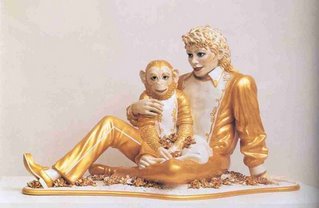
kasey offers this porcelain and ceramic depiction of michael jackson and his pet chimpanzee as an exemplary case of "blank irony."

i'm not sure to what extent this piece really demonstrates irony, "blank" or otherwise: what does it literally mean or want to say, and what additional meanings could then be inferred? my first impulse would be to call it an example of kitsch, i.e. so bad, tasteless and tacky that it's "good." (or maybe this makes it more "camp" than "kitsch," i'm not sure.)

to read it ironically, we would first have to posit a viewer for whom the piece is simply a depiction of michael jackson and his pet chimpanzee, and an aesthetically pleasing one at that. a fan perhaps, a collector of thrift-shop curios who would find this object suitable for one's mantlepiece, etc. (altho according to the san francisco MOMA, this piece in actuality is some 42 by 70 by 32 inches and thus hardly a "curio" suitable for one's mantle).

by most accounts of how irony works, this viewer would be considered not to have sufficient knowledge, literacy or competence in interpreting "art."

so what else might this piece be saying? whether it's critiquing superstardom and celebrity status, the relationship between popular and high cultures, jackson's own behaviors and tastes that range from the idiosyncratic to the neurotic and potentially criminal, etc., kasey suggests that none of these interpretations salvage or absolve the piece from the level of bad taste, and that
On another level, Koons' sculpture ironizes the artist's and/or viewer's confidence in his or her ability to separate brute aesthetic response from critical reflection. The "bad taste" of the object is only a conceit, a placeholder. It enforces the suspension of evaluative judgment rather than directing such judgment to a conclusion. Or, if a conclusion is reached, it is by way of the viewer's predisposition to reject the aesthetic experience offered by the object, not through any "readable" content available to the viewer therein.
essentially then, the piece offers us a lesson in how we as viewers with a certain literacy interpret or respond to kitsch. and i think there's no denying that for kasey this level of interpretation is not simply "another" level of irony but a more complex, sophisticated and nuanced level. it is at this level that we are invited to "get over" our initial displeasure at how "bad" this piece is and, in kasey's words, suspend our evaluative judgment, keep open the question of whether we "like" it or not. moreover, if we can't do this, kasey claims, it's because of "the viewer's predisposition to reject the aesthetic experience offered by the object, not through any 'readable' content available to the viewer therein."

in other words, if you can't "get over it" and arrive at the more subtle and nuanced levels of interpretation, that's got nothing to do with the content of the piece itself and everything to do with you the viewer. "have an aesthetic experience," the piece offers; "none for me thanks," says the indisposed viewer.

though i can hardly agree with this analysis, it does seem in keeping with "blank irony" as formulated by fredric jameson and really elaborated more fully by wayne booth as "unstable irony,"
in which no stable reconstruction can be made out of the ruins revealed through the irony. The author -- insofar as we can discover him, and he is often very remote indeed -- refuses to declare himself, however subtly, for any stable proposition, even the opposite of whatever proposition his irony vigorously denies. [the rhetoric of irony, page 240]
booth goes on to further classify ironies, both stable and unstable, along the parameters of overt-covert and local-infinite, such that unstable-covert-infinite irony, the most extreme or radical form (his example is the fiction of samuel beckett), amounts to a vertiginous structure in which there is no interpretive level at which the reader/viewer is safe from being up-ended because the universe itself is replete with the instability of meaning that is irony's hallmark. booth sets the terms for this sort of zero-degree irony as follows:
If irony is, as Kierkegaard and the German Romantics taught the world, "absolute infinite negativity," [Kierkegaard's words] and if, as many believe, the world or universe or creation provides at no point a hard and fast resistance to further ironic corrosion, then all meanings dissolve into the one supreme meaning: No meaning!" (93)
i don't know if this is what koons or kasey are advocating (though i suspect it is), whether either or both of them honestly encourage us to "suspend evaluative judgment" infinitely or even indefinitely while we attain ever more rarified and subtle nuances of irony occasioned by a kitsch depiction of michael jackson and his pet chimpanzee (though i suspect they do). and while i certainly don't fear or bemoan this interpretive and intellectual space as wayne booth seems to, it's also not a space in which i want to spend a lot of time.

personally i don't find koons' depiction of michael jackson and his pet chimpanzee, and the various ironic critiques it could be making -- including those about my own aesthetic evaluations and judgments that i bring to and make about the piece -- very interesting, compelling or engaging. and not entirely (but somewhat) for reasons some of koons' critics maintain:
Mark Stevens of The New Republic dismissed him as a "decadent artist [who] lacks the imaginative will to do more than trivialize and italicise his themes and the tradition in which he works... He is another of those who serve the tacky rich." Michael Kimmelman of The New York Times saw "one last, pathetic gasp of the sort of self-promoting hype and sensationalism that characterized the worst of the 1980s" and threw in for good measure "artificial," "cheap" and "unabashedly cynical".
(as an aside: rarely would i make blanket dismissals like this; i actually think koons' basketballs, for example, are kind of interesting.)

no, when koons and his piece say, "have an aesthetic experience," i feel viewers are free, if they choose, to linger in that experience as long as they find it desirable or tolerable. but i find no inherent moral or aethestic superiority, implied in kasey's account as i read it, in so lingering. and if, after a certain period of contemplation, i finally say "no more for me, thanks," i have to insist, contrary to kasey, that this moment is not exclusively "reached... by way of the viewer's predisposition to reject the aesthetic experience offered by the object" rather than "through any 'readable' content available to the viewer therein."

no, this moment happens in the space between viewer and object and the mutual obligations to each other that are created therein. it is a space to which producer, consumer and object are all party. and herein lies the inevitable evaluative moment that ultimately grounds all interpretative acts, ironic or otherwise. kasey recognizes this moment or space but arrives at a conclusion with respect to it that is antithetical to my own. he writes that
The "blankness" of Koons' irony, then is not a poverty of commitment to some moral ideal, not a failure to "take a position." It is a calculated leaving-empty within the coordinates of an imaginary field. The parts of this field that have already been "filled in" seem to invite a continued filling-in, leading toward an inevitable completion of a figure. But there is no way to complete such a figure without encountering irremediable contradictions that ultimately prohibit the possibility of a realized figure at all. [NB: behold, absolute infinite negativity!]

I am speaking, of course, not of a spatial figure, but of an ethical one. It may be that aporetic contradiction is in the nature of all ethical figures, and that it is irony's signature quality to limn this aporia.
koons may "limn" -- illuminate, embellish or simply depict -- a space of ethical contradiction via michael jackson and his pet chimpanzee here, but i really fail to see how. and if he does, he's sure not shedding much light on it for me or helping me understand it. frankly i don't even know if this piece broaches any ethical matters at all, let alone anything worth taking an ethical stand on.

but if it did -- supposing that the piece sexualized a child, for example, which is certainly within the realm of possibility where michael jackson is concerned -- would we not want something more than "a calculated leaving empty"? one may have a committment to a moral ideal (that it is wrong to sexualize children, for example), but if one fails to "take a position," then how is that moral ideal ever made known or asserted? isn't the "suspension of evaluative judgment" that kasey finds koons' blank irony "enforcing" itself an evaluative and hence ethical judgment? doesn't a failure to take a position in ethical matters effectively amount to a poverty of commitment? what good is a moral ideal if it is not acted upon?

if art deploying blank irony is "a calculated leaving-empty" that "seem[s] to invite a continued filling-in," then the pederast and anti-pederast alike "fill in the ethical space" created by the work, each according to his or her own whims. the pederast will find nothing in the work to confront the unethical nature of pederasty, will in fact come away from the work unchanged, perhaps even validated. the work has changed nothing and no one. and if (borrowing kasey's language) it is blank irony's signature quality to limn the aporetic contradiction of the ethical space created in and by the work, that limning has done nothing, finally, but aestheticize that ethical space.

Thursday, September 28, 2006

fall museum preview

culled from ken johnson's piece in the nytimes (subscription only, email me if you want the whole thing) from a few weeks ago. very eastcoast-centric, but i include exhibits closer to some of you and also within my possible striking distance (travelling exhibits noted when the info was available,... hello san diego!)

John Armleder, About Nothing: Works on Paper 1962-2007
Institute of Contemporary Art, Philadelphia
through December 17, 2006
John Armleder (b. 1948, Geneva, Switzerland, lives Geneva) is a performance artist, sculptor, and painter, whose multi-faceted activities are connected by drawing. Affiliated with Fluxus in the late 1960s and 70s, the value of ephemerality and notion that art is the conduction of creative energy are imperative to his work. During the 1980s, his "furniture sculpture" was highly visible within the context of "New Geometry" or "Neo Geo." This is the first major exhibition of John Armleder's work in the United States.

Enigma Variations: Philip Guston and Giorgio de Chirico
Santa Monica Museum of Art, California
through November 25, 2006
...will explore the influence of de Chirico’s distinctive vision on Guston, while illustrating Guston’s ability to transform inspiration through the inimitable lens of his creative consciousness.

Massive Change: The Future of Global Design
Museum of Contemporary Art Chicago
Through December 31, 2006
Conceived by the internationally renowned designer Bruce Mau, the exhibition invites viewers to consider the dynamic future of design culture and the real choices we must make. Massive Change is dramatic, engaging and critical, immersing visitors in a series of powerful encounters with the latest innovations in the fields of urban design, transportation, information design, revolutionary material and more.

Picasso and American Art
Whitney Museum of American Art, NYC
Through January 28, 2007
Picasso's influence on American artists is the theme of a show juxtaposing Picasso's works with those of Stuart Davis, Arshile Gorky, Willem de Kooning, Jackson Pollock, Andy Warhol, Jasper Johns and others. Travels to San Francisco Museum of Modern Art (Feb. 23 to May 28); Walker Art Center, Minneapolis (June 17 to Sept. 9, 2007).

Steve Reich at the Whitney: A Performance Event
Whitney Museum of American Art, NYC
Sunday October 15, 2006 2 - 6 pm
The Whitney pays special tribute to Reich with four hours of Reich’s music performed by some of today’s most exciting young contemporary music ensembles, including Alarm Will Sound, Prism Saxophone Quartet, So Percussion, and the Manhattan School of Music’s TACTUS, as well as Ransom Wilson and other accomplished Reich performers.

Bob Dylan's American Journey, 1956-1966
Morgan Library and Museum, NYC
Through January 6, 2007
The first big museum exhibition to study Mr. Dylan's early career will present historical artifacts -- handwritten lyrics, letters, instruments and photographs -- as well as films of performances by and interviews with him and others.

Lucio Fontana: Venice/New York
Guggenheim Museum, NYC
October 10, 2006 – January 21, 2007
The first major United States exhibition since 1977 to be devoted to this Italian avant-gardist known for slashing and puncturing his painted canvases and metal panels.

Courbet and the Modern Landscape
The Walters Art Museum, Baltimore
October 15, 2006 - January 07, 2007
Courbet's landscape paintings of the 1860s defined the essential artistic issues that would concern the next generation of avant-garde painters (who would be called the impressionists), changing the course of painting for the next 100 years. Despite its enormous significance, Courbet's landscape painting received surprisingly little consideration in exhibition form. This show will focus on 37 landscape paintings, which demonstrate how Courbet was a radical innovator both in the motifs he chose to paint and in the dramatic brushwork of his paintings.

Barcelona & Modernity: Picasso, Gaudi, Miro, Dali
Cleveland Museum of Art
October 15, 2006 - January 7, 2007
The first comprehensive exhibition (over 300 works) to focus on the Catalan Renaissance, a period of extraordinary artistic fertility centered in Barcelona from the late 1880's until Franco took power in 1939.

Ehon: The Artist and the Book in Japan
New York Public Library
October 20, 2006 - February 4, 2007
The Japanese literary tradition, dating from as early as the 8th century, is among the richest and most enduring of any country in the world, and ehon, or "picture books," although little known in the West are one of the glories of world art. Ehon: The Artist and the Book in Japan will demonstrate the variety of visual languages used by artists over many historical periods from 764 to 2005. It will include approximately 200 books with printed illustrations, as well as related manuscripts, drawings, woodblock prints, and photographs.

John Latham: Time Base and the Universe
P.S.1 Contemporary Art Center, NYC
October 29, 2006 - January 8, 2007
An exhibition of approximately thirty works by the late British artist John Latham (1921-2006). Conceived with the artist prior to his death in January 2006, the show surveys the major stages of his career, spanning over fifty years. With his uncompromising endeavor to explore some of the most complex cosmological ideas through art, and due to his criticism of the art market, he was both acclaimed and vilified in his lifetime. Visceral and enigmatic, his work encompassed sculpture, performance, installation, film, conceptual, and book art.

Music is a Better Noise
P.S.1 Contemporary Art Center
October 29, 2006 - January 8, 2007
Music is a Better Noise brings together musicians who make art and artists who make music, or for whom music is an integral part of their creative process. The exhibition, featured in two parts in P.S.1’s first floor Drawing and Painting Galleries, also includes a video program in the Vault.

Brice Marden retrospective
Museum of Modern Art, NYC
October 29, 2006 - January 15, 2007
From his monochromatic abstractions of the 70's to his recent compositions of meandering colored lines, Mr. Marden has produced the most consistently sensuous and elegant American painting of the last four decades. This retrospective will present 50 paintings and 50 drawings from all phases of his career. Travels to San Francisco Museum of Modern Art (Feb. 17 to May 13).

Albers And Moholy-Nagy: From The Bauhaus To The New World
Whitney Museum of American Art, NYC
Through January 21, 2007
Josef Albers and László Moholy-Nagy were two of the greatest pioneers of modernism in the twentieth century. This exhibition focuses on their individual accomplishments as well as the parallels in their work and examines their groundbreaking development of abstract art beginning in the early 1920s.


Morris Louis Now: An American Master Revisited

High Museum of Art, Atlanta
November 4, 2006 through January 24, 2007
The first consideration of Louis’s work in the United States since 1986 and offers a critical re-examination of this influential painter’s legacy. Featuring approximately 30 canvases produced from 1951 through 1962, Morris Louis Now examines the work that defined Louis’ career and that contributed to a critical turning point in American art. Louis worked in an innovative manner by “staining” the canvas with thinned acrylic pigments, using intense, rich washes of color to create unified compositions. Travels to the Museum of Contemporary Art, San Diego (Feb. 17 to May 6).

Joseph Cornell: Navigating the Imagination
Smithsonian American Art Museum
November 17, 2006 - February 19, 2007
The first full-scale survey of this great American Surrealist in 25 years includes boxes, collages, films and graphic designs among its 200 works.

Magritte and Contemporary Art: The Treachery of Images
Los Angeles County Museum of Art
November 19, 2006 – March 4, 2007
Will present forty to fifty Magritte paintings along with an equal number of paintings and sculptures by international artists working over the past forty years and will include the work of Jasper Johns, Ed Ruscha, Vija Celmins, Joseph Kosuth, Sherrie Levine, Richard Artschwager, Jeff Koons, Martin Kippenberger, Jim Shaw, Raymond Pettibon, Robert Gober and Marcel Broodthaers.

looking even further ahead: bruce nauman in berkeley, jasper johns at the NGA...

Monday, September 04, 2006

klee and jacquot

rounding out my holiday weekend of film and about-to-close art shows, i trekked over to the phillips collection yesterday for the first time in probably 2-1/2 years, and certainly since their new wing opened up, apparently just this past april. before even heading up to the "paul klee in america" exhibit i browsed around and was quickly reminded what i fine permanent collection they have. by people i know -- an early pollock, a great motherwell, (chi ama, crede) that i can't find a photo of, gustons (early and late), a nice albers and noland, two interesting early rothkos and a little "rothko room" with four (i think) of his more mature works. plus, lots of nice pieces by people i don't know at all -- john walker's october low tide, maine and ostraca II, howard hodgkin's torso, and joan mitchell's august, rue daguerre.

klee is someone i've had an affinity with going back to grade school, maybe 5th grade. i think they had some students from the local college come in and teach us some art at some point, because i remember being to look through art books and find something you liked and imitate it. the result is one of very few surviving childhood artworks of mine, never having thought i had much talent. but i titled it "head of an archaeologist by paul klee" and i've never found any painting of klee's by that name but i'd surely like to figure out some day what professional's head i was imitating that day.

anyway this was a terrific exhibit (it's up through this sunday), with something like 80 of his works on display, mostly from the 1920s i'd say though some into the 1930s. i have to say a number of things that struck me about klee: first, luminosity. der angler is a great example of this. he frequently manages to get this incredible luminosity behind the central figures in the paintings; although it's a very different quality, rothko immeidately comes to mind as someone for whom luminosity is an important quality.

second, palette: what an incredible range of colors he draws upon, so unlike the next couple of generations i think (rothko, still, reinhardt) as much as i like them.


(Photographs by Mark Harden)


third, scale: utterly modest, they don't try to bowl you over with their awesomeness. fourth, media: an incredible variety (oil, water, mixed with various other substances and applied to all kinds of surfaces) and yet with a remarkable consistency. and fifth, lines: clear and for the most part precise. notice in all this i fail to call attention to the whole "childlike" quality that is so often taken to characterize his work. it's too easy a characterization i think, misses something somehow. it's an other part of consciousness he's tapping into, bringing together many of the impulses of his surrealist peers without being reducible to any of them.

------------------

benoît jacquot's musician-assassin was a strange film. the protagonist, gilles, is a violinist who is so convinced of his own excellence that he refuses to compromise his genius by earning money playing in an orchestra or teaching. it could be an interesting commentary on artistic integrity and the marketplace, but the dramaturgy unfolds in such deadpan that it's hard to do anything but take gilles to be a joke or parody of integrity ad absurdam.

i'll be curious to see where the rest of the NGA's jacquot mini-retrospective turns out.

Friday, September 01, 2006

menken and kiefer

refusing to let ernesto spoil the last day of my summer, i went down to the national gallery to see martina kudlácek's 2005 documentary notes on marie menken. (an aside: the free films in the basement of the national gallery's east wing are one of the true treasures of life in this nation's capital. i don't take advantage of it as often as i should but this month they're featuring films by benoît jacquot so i'll be checking that out.)

knowing next to nothing about menken except that she was an experimental filmmaker, and not even having heard of her when i published a poem of drew gardner's named after her a few years ago, turns out that she didn't just teach andy warhol how to make films. one of the very first things i see and hear upon walking into the movie 30 minutes late -- never trust the city paper's screening times! -- is stan brakhage claiming that the single most important filmmaking predecessor for his own concerns is marie menken! of course, kudlácek then cuts immediately to an excerpt of menken's eye music in red major (1961) and the connection is more than obvious.

readers in DC have one more chance to see this at the NGA (sunday at 2pm), and it's worth it not only for pure info and background. there are moments when it's quite nicely shot too: one scene in particular where kudlácek's footage of a carnival ride litlerally morphs into pure brushstrokes. there are some moments too where the narrative wanders and makes the film feel like it was really only a 70-minute film that was stretched to make it 97 minutes (particularly when we follow gerard malanga into queens to visit his father's crypt). other moments tho were quite a joy: malanga discovering footage of menken and warhol shooting footage of each other on a rooftop and him and warhol making silkscreens in warhol's studio in late 1963 for example; kenneth anger talking about how marie and her husband used to get drunk and spar with each other all weekend; brakhage describing menken's discovery of the hypnogagic vision; peter kubelka describing the poetics of the bolex camera; and jonas mekas singing and translating the lithuanian children's song that menken sang to him once.

i then decided i'd better see the "anselm kiefer: heaven and earth" show at the hirshhorn before it closes next weekend. (typically, it was here all summer and i might have missed it altogether.) i think overall i'm not really crazy about kiefer's work, tho there are aspects to it i do like. on a level of painterly technique i do like the texture of the big oils on the big burlap canvases, but his palette is so limited, so unremittingly dark. (the watercolors he did in the 1970s, like winter landscape, offer quite a refreshing contrast: brighter color, cleaner lines.)

thematically he's also so... obvious. darkness, big darkness, massive inhumanity, a bit of humor (dark of course). really leaves so little to the imagination. even when kiefer gets sculptural and puts affixes objects into the flat dimensions of the canvas -- like the hierarchy of angels that has an airplane propeller in it, the title an obvious nod to rilke's duino elegies -- it's all so obvious in ways that rauschenberg for example never is.

however i do like him more as a book artist, especially when he combines that with his cosmological speculations. there are the early (1969) books called the heavens which look to have simple watercolors and pasteups in them. then there's cauterization of the rural district of buchen (1975), books made up of old canvases of his that he had burned.


followed two decades later (this is hardly a complete survey, i'm just pulling stuff i mades notes on and that the hirshhorn website has pictures of) by book with wings (1992-1994), which speaks for itself


more recently we get the secret life of plants (2001), a giant upright book that asserts the kinship between individual plant cells and the starry heavens...


followed by for robert fludd (2003) which resembles a giant book of start charts with mages made of lead, meteorites, this time featuring giant lead books on a bookshelf that has been pummeled by meteorites

which means i guess i like kiefer the book artist far more than keifer the painter.

tonight: comets on fire at the black cat!

Sunday, July 09, 2006

from charing cross road

...which i only JUST found out is london's haven for used booksellers. i have come to england hopefully as a prepared job candidate but woefully underprepared as a tourist.

the overnight trips to europe pretty much always put me on no sleep for the next day. but you have to tough it out, and unprepared it can be pretty tough. but fun! after landing at heathrow at what was for me 2:30am EDT and going through a tortuously long customs line, my only plan was to 1) buy a cheap travel guide, 2) find an ATM and get myself some brit cash money, and 3) get to waterloo station and store my larger carryon bag for the night so that i wouldn't have to drag it all over town with me today and could instead just pick it up before getting the train to southampton. all three missions accomplished, however bleary-eyed!

my only other plan was to see the tate modern: which, as it turns out, is within easy walking distance of waterloo station, right along the south bank of the mighty murky thames. perfect. and what is the very last restaurant i come to along the bank before arriving at the tate: a joint run by the fine folks at young's brewery! trust me tho, the many interesting kinds of young's beer on tap they had to offer looked tempting, but coffee had to be my drink of choice to go alongside the traditional "full english breakfast" of eggs, bacon, sausage, toast, beans, tomatos, and mushrooms. sounds weird, and frankly the last three items indeed are what make it weird: beans, as in baked beans, in a straight tomato-y sauce (not barbequed and molassassed at all), sorta straight outta the can; tomatos, as in stewed whole plum tomatoes, also seemingly straight outta the can; and little whole mushrooms, browned somehow, and like straight out of a jar rather than a can. but who the hell cares it was all totally tasty and worked for me.

and what is the big exhibit currently running at the tate modern? kandinsky: the road to abstraction! (or maybe it was the path to abstraction. ok yes, path.) oh it was so good. i heart kandinsky in a big way, and it was completely fascinating to see where he was coming from, as this was all stuff from 1908-1921. nine huge rooms of it! too much of course. but fascinating. like he was 40 in 1908 and still painting landscapes! unusual ones of course, and he quickly went the impressionist and post-impressionist ways. heavy expressionist or as the would call it in franco-non-teutonic places, fauvism. (that's probably a hugely incorrect art-historical leap i'm making there, but it's he brashness of colors that unites the fauvists and the expressionists. or rather, early kandinsky is that link maybe?) anyway, the incredibly variety of tones, palattes, and lines he gets are quite something. by the time he gets to his signature style it makes absolute sense logically. i love that, when you get a larger sense of the whole career and see that, for example, wow rothko had a brief klee/surrealist phase, or wow sol le witt had the seemingly manditory ab-ex phase...

anyway the kandinsky really took the wind outta my sails (that and the 7-item breakfast), plus i foolishly took a quick tour through the one portion of the tate modern's permanent collection which was also bewilderingly awesome. but i totally ran out of gas, so needing sleep and so wishing i knew exactly what my plans were for the next 24 hours, so hoping they include sleep and a friendly face! my contacts here are either out of town till later in the evening or not able to put me up for the night and one i simply hadn't heard back from. so i tried feebly to nap sitting upright on benches in the museum, i spent sometime in the tate bookstore looking at cool english versions of theory books that i don't have. (and what's up with zizek? man he's crankin 'em out these days.) i even took a totally pointless walk across the thames and found a youth hostel international, if i'd found an obvious entranceway i wouldve gone in and inquired about accommodations there.

finally i decided i'd go back to the tate, pick up the briefcase i'd checked there and go to a bookstore mentioned in my cheap travel guide. picadilly was only a few tube stations away, so off i went. the bookstores were of course lame -- one with no poetry section at all, another with all new stuff (waterstone, sorta like borders), but it was very interesting to see what was in print from british publishers, what american poets get picked up by bloodaxe and carcanet (can you say carolyn forcche and tony hoagland among others), and what other interesting editions of the americans were available. for example i got totally excited to see a 2-volume "new york school poets" edited for carcanet by mark ford. i would so totally teach those books! he does a pretty good job overall it seems, esp vol 2 which contains excellent coolidge and ceravolo selections. big big mistake, however, to relegate barbara guest to vol 2. BIG mistake. plus both vols are super dude-heavy (good selection of mayer but no alice notley?!?!) and need to be supplemented pretty heavily.

anyhow the nice lady at the customer service desk told me that charing cross road is the place for used booksellers -- a 10 minute walk so off i went! even tho in all likelihood, she warned me, they would all be closed (after 6pm on a sunday). nevertheless, the walk along picadilly towards leicester square was much closer to what i'd imagined london to be like. bustling. the south bank area was all people strolling, eating, jogging even, with lame guys singing "time in a bottle" to acoustic guitar. (mark, there's some psychic oblivion for you!) and when i saw a sign for an internet cafe charging 1 pound for an hour of internet access -- stuff *is* expensive here, it's like 6£ (cool they have a "£" key on this keyboard!) for a decent breakfast or an all-day tube pass but then you realize that's 10USD, or 10£ to see the kandinsky and then you realize that's like 17USD. anyway i couldn't resist checking the email and found, lo and behold, my london contact whom i never heard from was at a poetry festival in cork! so he's back, mebbe we'll meet up and my need for human contact and a place to stay will be solved! gonna go phone him, soccer fans are screaming...

Sunday, June 04, 2006

sunday news and notes

and this is the industry that was going to finance our war efforts in iraq...

-------------------

this special congressional election "to fill the seat of a jailed Republican" (that would be blubbering duke cunningham) in hardcore red-state country may be an indication of how dems can succeed this fall. and dig this to get a sense of how quick the republicans will twist something to their advantage

------------------

books briefly reviewed by dave itzkoff and laura sinagra on:

pink floyd's dark side
charlie parker
the flaming lips
pop music and the urge for transcendence
and perhaps most interestingly, "echo and reverb: fabricating space in popular music recording, 1900-1960" by peter doyle. (hello taylor brady!)

-------------------

pollock at the guggenheim...

-------------------

the latest installment of an ongoing asia times series called "how to lose the 'war on terror'" by mark perry and alastair crooke

-------------------

the swift-boating of global warming continues unabated in the face of an inconvenient truth, as thinkprogress reports:

The National Review’s June 6 cover story, Scare of the Century by Jason Lee Steorts, has several serious errors and omissions. By distorting evidence, Steorts misleads his readers about the threats of global warming.


-------------------

Wednesday, April 05, 2006

more cezanne


ok, so especially in the late work ("Montagne Sainte Victoire," 1904-1906, above left) but as early as "The Bay from L'Estaque" (1886, above right) cezanne begins to collapse the depth of perspective and use line and shape in a way that anticipates cubism. i can see that. and i like these works more than, say, monet or renoir that's for sure. still doesn't seem all that earth-shattering to me.

Tuesday, April 04, 2006

cezanne

yesterday i was able to make an annoying trip to the canadian embassy (yes i must apply for a study permit even though i will not be living in the country or even enrolled for more than two semesters at the very most, the defense trip will surely take less than 48 hours) more fun by checking out the cezanne exhibit at the NGA.

frankly it was all very pretty and whatnot but i think i must be missing something. or maybe i've simply outgrown impressionism? like yeats or t.s. eliot, those first poets you really dug and which you don't really read or like much anymore but for whom you still have a softspot in yr heart. like at this point i'd rather have rather have the earlier, darker realists (courbet, manet, degas) or else over-the-top in the other direction (bonnard, vuillard, fauvists, expressionists, etc.) maybe i need to go back and reread those merleau-ponty essays and see what the fuss was about.

Sunday, March 26, 2006

some more dada notes

saw/heard ballet mécanique from a loftier perch this time and the impact is significantly diminished. still a great piece tho.

towards a collaborative research/poetics project

nodal points
  • anarchopacificm
  • chance
  • cage - mac low
  • plastics - explosives/prosthetics
  • taxonomy of collage
  • history of dada publications
  • schematics - ernst to braxton
  • hybrid bodies and machines
  • "This world of systems has gone to pieces" (Ball critiques Hegel)
  • untranslated writings (Picabia et al.)
  • the archives

aesthetic styles (emergent and residual)
  • "abstraction"
  • cubism (& cubo-futurism)
  • expressionism
  • impressionism / pointilism
  • "collage"

between pure abstraction and pure mimeticism
curvilinear abstraction (arp and taeuber: 17-26)
arp's move from geometrical to organic abstraction

           the beginning drop sifts a genesis

richter's fugue --> geometrical abstraction as schematic --> graphic notation --> anthony braxton's composition titles

factor also into such a history: picabia's joke schematics, ernst's use of schematics including quasi-organics (189) -- and bargeld 207-210 -- on the way to tanguey

between geometrical and organic abstraction: schadographs (60-65), schwitters lithos

           using existence a preferred fabric / jagged searching discovery assault

           assumed ineffectual measurable weights

cubism
  • janco (16)
  • segal (42) - cubofuturist
  • schwitters (187)

expressionism
  • richter (40-41)

               an adjacent retreat into self-hipnosis / primitive masklike identity

  • grosz (66)

impressionism/pointilism - taeuber's untitleds

berlin room

           dangles unflattening / allowed the hours / a text marching
           & / claimed the work


why do i still not know schlichter and dix?

grosz 72 - a vietnam of society (misread)
hausmann 96 - dylan's mr. jones

höch and hausmann have primacy of place in any taxonomy of collage

man ray aerographs (287-290) flirting with the geometrical-organic abstraction continuum

crotti --> schematic-like organic machines

Tuesday, February 21, 2006

dada notes

while i knew it was coming, it took ken and lauri saturday at the brewer's art in baltimore after his reading with lisa jarnot to reminded that the dada show opened sunday.

i was there with a cup of mobil oil coffee at 10:45am in 20 degree weather, when the line was not too bad. leaning on the handrail with a 40-foot L.H.O.O.Q. behind me, what a photo op! by 10:55 the line went down to constitution ave. with no sign of ken, lauri or adam, i walked on in.

the very first thing you're confronted with upon entering the exhibit is a 3-4 minute loop of WWI film footage. brutal shit: rows of amputes, clouds of mustard gas, a guy getting fitted with a prothetic face. i immediately sat down on a cushioned bench in front of the film next to an older couple. and after a short time i said out loud "i'm so glad their starting the exhibit with this." and the woman next to me said "i know, it's so important, people think this [dada] was all just a joke, but it had everything to do with the war." we commented to each other on the stream of catastrophes passing before our eyes: the mangled bodies, the destruction, the waste. "incredible that the same technology created the chemicals to destroy flesh and the prostheses to replace flesh" i said. "wasn't it the first war fought from the air" the man asked. "enjoy the show" they said as they left.

it felt good, when so much of what we do as artists is misunderstood if not spurned outright by this society of ours, to be in the national gallery of art, amidst throngs of people who have come to see the art that is so central to the past century and what many of us try to do today. to walk up the stairs and see the instructions for tzara's dada poem placed literally step by step, with "the poem will resemble you" at the top. to think of all the people who pass through the merz photoreproductions and hear schwitters' "ur sonate" maybe for the first time, and the security guard who will listen to it all day. the little kids who smile and get it because they haven't been taught yet to think otherwise.

initial impressions and recollections -- there will be many more. (and adam bought the catalog but i'm excited to go back through my motherwell anthology in honor and trubute...)

sophie taeuber! i never knew. heads, needlepoint (was there much dada handicraft?), marionettes.

the publications: in almost every room, a glass case at the center chock full of little mags. (reminds me of the russian futurist show at the whitney a few years back.)

janco's jazz --> cubist cezanne

arp drawings --> kandinsky/miro (cutout organic forms)

richter's "project for unrealized film fugue" --> ny school graphic notation scores

check films shown with one i have on my avant-garde films of the 1920s and 1930s DVDs.

the distinct feels the exhibition give to each city. berlin feels more expressionist, burlesque. baader's and hoch's collages.

hannover -- schwitters -- more muddily futurist?

merz lithos --> mccaffery's carnival

cologne -- cleaner?

ernst! why the surrealists loved him (i never understood before...)

new york -- slick?

crotti --> klee/tinguely (primitive organic machines)

different photographic processes -- man ray, who else?

paris -- humanist?

rrose sélavy & transvestitism?

ribemont-dessiagnes --> picabia

stop menacing me, rossignol!