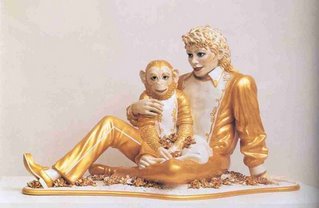
kasey
offers this porcelain and ceramic depiction of michael jackson and his pet chimpanzee as an exemplary case of "blank irony."
i'm not sure to what extent this piece really demonstrates irony, "blank" or otherwise: what does it literally mean or want to say, and what additional meanings could then be inferred? my first impulse would be to call it an example of kitsch, i.e. so bad, tasteless and tacky that it's "good." (or maybe this makes it more "camp" than "kitsch," i'm not sure.)
to read it ironically, we would first have to posit a viewer for whom the piece is simply a depiction of michael jackson and his pet chimpanzee, and an aesthetically pleasing one at that. a fan perhaps, a collector of thrift-shop curios who would find this object suitable for one's mantlepiece, etc. (altho according to the san francisco
MOMA, this piece in actuality is some 42 by 70 by 32 inches and thus hardly a "curio" suitable for one's mantle).
by most accounts of how irony works, this viewer would be considered not to have sufficient knowledge, literacy or competence in interpreting "art."
so what else might this piece be saying? whether it's critiquing superstardom and celebrity status, the relationship between popular and high cultures, jackson's own behaviors and tastes that range from the idiosyncratic to the neurotic and potentially criminal, etc., kasey suggests that none of these interpretations salvage or absolve the piece from the level of bad taste, and that
On another level, Koons' sculpture ironizes the artist's and/or viewer's confidence in his or her ability to separate brute aesthetic response from critical reflection. The "bad taste" of the object is only a conceit, a placeholder. It enforces the suspension of evaluative judgment rather than directing such judgment to a conclusion. Or, if a conclusion is reached, it is by way of the viewer's predisposition to reject the aesthetic experience offered by the object, not through any "readable" content available to the viewer therein.
essentially then, the piece offers us a lesson in how we as viewers with a certain literacy interpret or respond to kitsch. and i think there's no denying that for kasey this level of interpretation is not simply "another" level of irony but a more complex, sophisticated and nuanced level. it is at this level that we are invited to "get over" our initial displeasure at how "bad" this piece is and, in kasey's words, suspend our evaluative judgment, keep open the question of whether we "like" it or not. moreover, if we can't do this, kasey claims, it's because of "the viewer's predisposition to reject the aesthetic experience offered by the object, not through any 'readable' content available to the viewer therein."
in other words, if you can't "get over it" and arrive at the more subtle and nuanced levels of interpretation, that's got nothing to do with the content of the piece itself and everything to do with you the viewer. "have an aesthetic experience," the piece offers; "none for me thanks," says the indisposed viewer.
though i can hardly agree with this analysis, it does seem in keeping with "blank irony" as formulated by fredric jameson and really elaborated more fully by wayne booth as "unstable irony,"
in which no stable reconstruction can be made out of the ruins revealed through the irony. The author -- insofar as we can discover him, and he is often very remote indeed -- refuses to declare himself, however subtly, for any stable proposition, even the opposite of whatever proposition his irony vigorously denies. [the rhetoric of irony, page 240]
booth goes on to further classify ironies, both stable and unstable, along the parameters of overt-covert and local-infinite, such that unstable-covert-infinite irony, the most extreme or radical form (his example is the fiction of samuel beckett), amounts to a vertiginous structure in which there is no interpretive level at which the reader/viewer is safe from being up-ended because the universe itself is replete with the instability of meaning that is irony's hallmark. booth sets the terms for this sort of zero-degree irony as follows:
If irony is, as Kierkegaard and the German Romantics taught the world, "absolute infinite negativity," [Kierkegaard's words] and if, as many believe, the world or universe or creation provides at no point a hard and fast resistance to further ironic corrosion, then all meanings dissolve into the one supreme meaning: No meaning!" (93)
i don't know if this is what koons or kasey are advocating (though i suspect it is), whether either or both of them honestly encourage us to "suspend evaluative judgment" infinitely or even indefinitely while we attain ever more rarified and subtle nuances of irony occasioned by a kitsch depiction of michael jackson and his pet chimpanzee (though i suspect they do). and while i certainly don't fear or bemoan this interpretive and intellectual space as wayne booth seems to, it's also not a space in which i want to spend a lot of time.
personally i don't find koons' depiction of michael jackson and his pet chimpanzee, and the various ironic critiques it could be making -- including those about my own aesthetic evaluations and judgments that i bring to and make about the piece -- very interesting, compelling or engaging. and not entirely (but somewhat) for reasons some of koons' critics
maintain:
Mark Stevens of The New Republic dismissed him as a "decadent artist [who] lacks the imaginative will to do more than trivialize and italicise his themes and the tradition in which he works... He is another of those who serve the tacky rich." Michael Kimmelman of The New York Times saw "one last, pathetic gasp of the sort of self-promoting hype and sensationalism that characterized the worst of the 1980s" and threw in for good measure "artificial," "cheap" and "unabashedly cynical".
(as an aside: rarely would i make blanket dismissals like this; i actually think koons' basketballs, for example, are kind of interesting.)
no, when koons and his piece say, "have an aesthetic experience," i feel viewers are free, if they choose, to linger in that experience as long as they find it desirable or tolerable. but i find no inherent moral or aethestic superiority, implied in kasey's account as i read it, in so lingering. and if, after a certain period of contemplation, i finally say "no more for me, thanks," i have to insist, contrary to kasey, that this moment is not exclusively "reached... by way of the viewer's predisposition to reject the aesthetic experience offered by the object" rather than "through any 'readable' content available to the viewer therein."
no, this moment happens in the space between viewer and object and the mutual obligations to each other that are created therein. it is a space to which producer, consumer and object are all party. and herein lies the inevitable evaluative moment that ultimately grounds all interpretative acts, ironic or otherwise. kasey recognizes this moment or space but arrives at a conclusion with respect to it that is antithetical to my own. he writes that
The "blankness" of Koons' irony, then is not a poverty of commitment to some moral ideal, not a failure to "take a position." It is a calculated leaving-empty within the coordinates of an imaginary field. The parts of this field that have already been "filled in" seem to invite a continued filling-in, leading toward an inevitable completion of a figure. But there is no way to complete such a figure without encountering irremediable contradictions that ultimately prohibit the possibility of a realized figure at all. [NB: behold, absolute infinite negativity!]
I am speaking, of course, not of a spatial figure, but of an ethical one. It may be that aporetic contradiction is in the nature of all ethical figures, and that it is irony's signature quality to limn this aporia.
koons may "limn" -- illuminate, embellish or simply depict -- a space of ethical contradiction via michael jackson and his pet chimpanzee here, but i really fail to see how. and if he does, he's sure not shedding much light on it for me or helping me understand it. frankly i don't even know if this piece broaches any ethical matters at all, let alone anything worth taking an ethical stand on.
but if it did -- supposing that the piece sexualized a child, for example, which is certainly within the realm of possibility where michael jackson is concerned -- would we not want something more than "a calculated leaving empty"? one may have a committment to a moral ideal (that it is wrong to sexualize children, for example), but if one fails to "take a position," then how is that moral ideal ever made known or asserted? isn't the "suspension of evaluative judgment" that kasey finds koons' blank irony "enforcing" itself an evaluative and hence ethical judgment? doesn't a failure to take a position in ethical matters effectively amount to a poverty of commitment? what good is a moral ideal if it is not acted upon?
if art deploying blank irony is "a calculated leaving-empty" that "seem[s] to invite a continued filling-in," then the pederast and anti-pederast alike "fill in the ethical space" created by the work, each according to his or her own whims. the pederast will find nothing in the work to confront the unethical nature of pederasty, will in fact come away from the work unchanged, perhaps even validated. the work has changed nothing and no one. and if (borrowing kasey's language) it is blank irony's signature quality to limn the aporetic contradiction of the ethical space created in and by the work, that limning has done nothing, finally, but aestheticize that ethical space.
 Right now I feel pretty pessimistic about social space. Contemporary American culture is such a degraded linguistic environment. Have you seen that Taco Bell ad where a chihuahua, dressed like Pancho Villa or Che Guevara, encourages a cheering peasant army to try the revolutionary new taco, the Gordita? So much for the avant-garde. What do we do?

 if i were to continue in a study of irony i would leave behind wayne booth, whose palpable dismay at the unstable-covert-infinite irony in the work of samuel beckett i do not share, and take up the more recent studies of linda hutcheon and claire colebrook. (all these texts are fully searchable online at amazon.) nevertheless, i found a passage in booth's rhetoric of irony (1974) that i think speaks very well to the orientation of my own poetics, namely a preference for metaphor over irony:
 I once had a student who wrote a paper about the joys of deer hunting, including a vivid description of the thrill that "coursed through" his veins as he cut the deer's throat and watched the life dying in those "large, beautiful, child-like eyes." It was evident to me that he was satirizing blood sport. But I found, in what seems now to have been one of the most ineffectual conferences I have ever had with a student, that my ironic reading was to him plain crazy. I made the mistake of lingering over his bloodthirsty phrases, trying to explain to him why I had thought them ironic. But he was simply baffled, as well he might be; to read irony in any one of his statements was to misunderstand his entire perception of what his life and the deer's were all about. Wrestling with irony, he and I were not talking only about "verbal" matters; we were driven into debate about how a man should live. [Wayne Booth,